

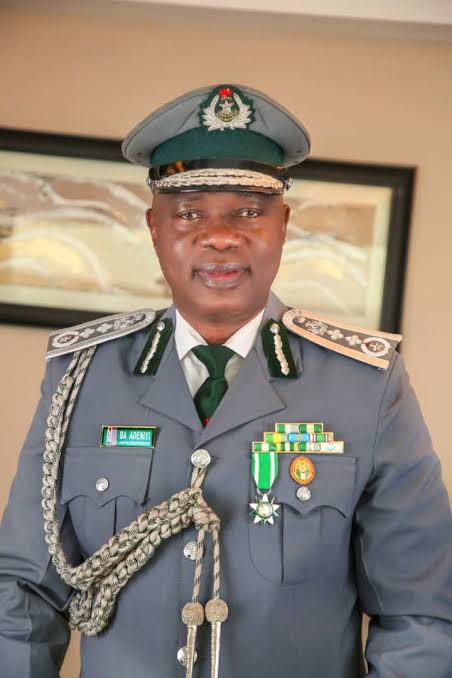
The Nigeria Customs Service (NCS) has described its newly introduced smart port technology, known as B’Odogwu, as a transformative tool for seamless trade facilitation across the country’s Ports and border stations.
Comptroller-General of Customs, Bashir Adewale Adeniyi, MFR, made this known at the Conference and Award Ceremony of the Association of Maritime Journalists of Nigeria (AMJON), held in Lagos.
Speaking on the theme “B’Odogwu as Game Changer for Optimal Trade Facilitation: Journey So Far”, the Customs boss said the innovation reflects the Service’s determination to align with global trends driven by automation, artificial intelligence, and robust inter-agency collaboration.
According to him, the Unified Customs Management System, B’Odogwu, marks a major leap in Nigeria’s trade modernization agenda.
“B’Odogwu is much more than a software. It is the digital backbone of a modern customs administration,” Adeniyi stated. “It integrates Form M, PAAR, Single Goods Declaration, manifests, duty payments and cargo release into one web-based platform accessible from anywhere, and seamlessly connects Customs with CBN, banks, SON, NAFDAC, FIRS and other regulatory agencies. This level of integration is unprecedented.”
He explained that the platform is central to Nigeria’s commitment to the WTO Trade Facilitation Agreement, AfCFTA, and the Nigeria Customs Service Act 2023, all of which demand faster, transparent and technology-driven border procedures.
The CGC noted that the system was first deployed at PTML in late 2024, where over 16,000 declarations were processed, before expanding to Apapa, Tin Can Island, Onne and several free zones including the Lagos Free Trade Zone and the Oil & Gas corridor.
Today, he said, several ports and borders run fully on B’Odogwu, with impressive results.
“Beyond revenue, clearance time has dropped significantly. With clean and compliant documentation, some stakeholders now complete processes within four to eight hours,” he said.
He added that the system has reduced dwell time, increased transparency, minimized human contact and strengthened compliance through enhanced digital footprints. It also improves risk management by distinguishing low-risk from high-risk shipments, enabling faster clearance for compliant traders.
CGC Adeniyi acknowledged initial challenges such as delays in transmitting SONCAP certificates, occasional system slowing, internet connectivity issues in some locations and the learning curve associated with transitioning from NICIS II.
“These challenges are natural for a reform of this magnitude,” he said, adding that the Service responded with continuous upgrades, multi-agency coordination, stakeholder engagement and sustained training.
Journalists as Partners
The CGC emphasized the crucial role of maritime journalists in ensuring public understanding of the reform.
“B’Odogwu needs accurate interpretation, not misinformation,” he said. “Journalists provide the bridge between policy and the people by reporting successes, highlighting challenges and offering constructive oversight.”
He outlined steps taken by the Service to consolidate progress, including nationwide rollout, strengthened inter-agency harmonization, continuous training, responsive help-desk support and sustained media engagement with groups such as AMJON.
Adeniyi concluded that B’Odogwu is already transforming Nigeria’s trade environment and will further enhance the country’s competitiveness, attract investment and lower the cost of doing business.