

The Dangote Petroleum Refinery is positioning itself as a major driver of Africa’s manufacturing and industrial value chain as it embarks on expansion projects that extend well beyond fuel production.
The Managing Director and Chief Executive Officer of the refinery, David Bird, disclosed that the facility plans to double its capacity to become the world’s largest refinery, while also developing a large-scale diesel hydrotreater, expanding polypropylene production, constructing additional marine jetties and building a world-scale Linear Alkyl Benzene (LAB) plant to support detergent manufacturing in Africa.
Bird described the refinery as a “continent-building project,” noting that beyond meeting Nigeria’s domestic fuel needs, it is set to transform energy trade flows across Africa and the Atlantic region.
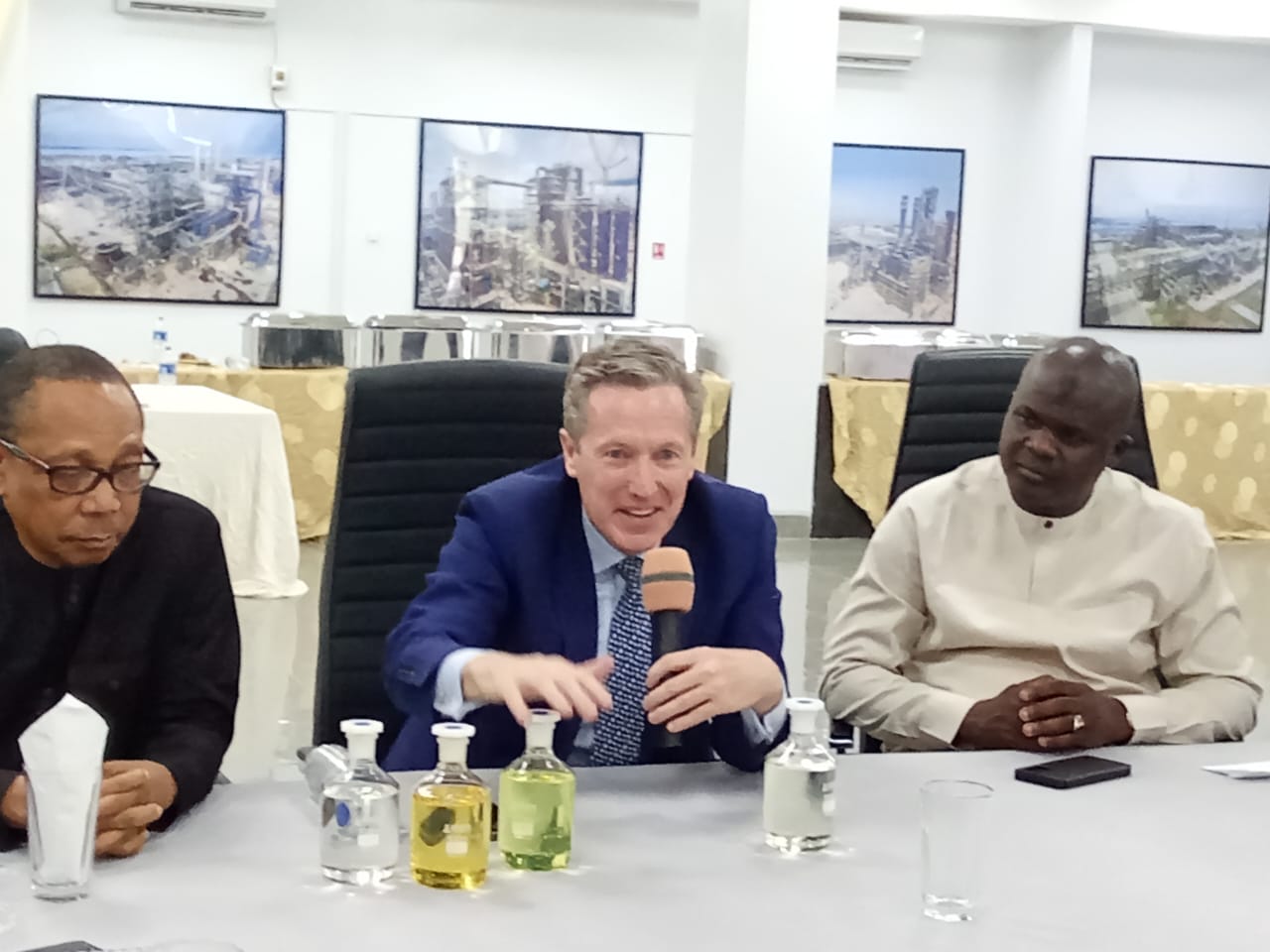
Speaking to journalists who toured the facility on Tuesday, February 17, 2026, Bird said the refinery has moved from construction into full-scale operations and is now transitioning into a safe, stable and highly efficient commercial enterprise capable of generating revenues to fund its ambitious expansion plans.
According to him, the refinery is already exporting refined products to global markets, including shipments of gasoline to New York Harbour, Bermuda and South America, as well as aviation fuel to Dubai, demonstrating its ability to compete internationally.
Bird explained that the refinery operates as a “merchant refinery,” a globally accepted model in which crude oil and intermediate feedstocks are sourced from different parts of the world and processed into finished fuels. He said this model allows the refinery to maintain high utilisation of its processing units and ensure steady fuel supply to the Nigerian market, even when some units undergo routine maintenance.
He clarified that the refinery does not import finished petrol for sale in Nigeria but rather imports intermediate feedstocks and blending components, which are further processed into high-quality finished fuels that meet Euro 5 specifications. He stressed that only finished, on-spec products are supplied to the market.
Bird further disclosed that the refinery has processed more than 25 different crude oil grades from Nigeria and other countries, including Brazil, Angola and Senegal, while also sourcing feedstocks from as far as South America. He said Nigerian crude remains the most attractive feedstock due to proximity and cost advantages, adding that the company is working to expand its crude-for-naira arrangement to deepen local sourcing.
Addressing public concerns over recent maintenance activities, Bird explained that the temporary shutdown of some units was part of routine “pit stop” maintenance common after major project start-ups. He said despite the maintenance, the refinery maintained supply to the domestic market by sourcing intermediate feedstocks to keep downstream units running.
He added that the refinery averaged about 41 million litres of petrol supply daily during the maintenance period, demonstrating the resilience of its operations.
On fuel quality, Bird said the refinery is producing Euro 5-grade petrol, diesel and aviation fuel, which are low in sulphur and free of harmful metals. He noted that the introduction of cleaner fuels has significant public health benefits, adding that Nigerians deserve the same fuel quality standards enjoyed in Europe and North America.
He reaffirmed that the refinery’s sole focus is refining and upgrading crude and intermediate feedstocks into high-quality fuels for Nigeria and export markets, adding that strong regulation and transparency remain key to maintaining public confidence in the refinery’s operations.
“It’s incredible to know what has been achieved to bring this project to life. Now, we’re transitioning it into a safe, stable, reliable, highly efficient, disciplined operating organisation that can generate revenues and earn its right to grow. There’s a very ambitious growth agenda.
“We will become the largest refinery in the world, right here in Nigeria. But that could all be done on the back of having a very efficient first phase of operation. It’s not just scale that we’re growing.
“This will be seen not as just a large refinery, but the most efficient and most competitive refinery. From a hardware perspective, credit to the vision and ambition goes to Aliko Dangote,” he said.
Providing further insight into the infrastructure supporting the refinery’s industrial and export ambitions, Captain Satendra Singh Rana, Head of Port Infrastructure and Marine Operations, said the facility has recorded over 800 tanker calls at its offshore marine terminals since operations commenced.
Speaking at the refinery’s landfall point, where subsea pipelines from offshore Single Point Mooring (SPM) terminals connect to the onshore processing facilities, Rana said the refinery operates five offshore SPMs, two dedicated to crude oil import and three for refined products.
He explained that the marine facilities are designed to turn around vessels within 24 hours on average, with even the largest tankers typically completed within 36 hours.
Rana added that the offshore location of the SPMs allows the refinery to benefit from natural water depths of about 40 metres for crude oil terminals and 20 metres for product terminals, eliminating the need for continuous dredging.
He said the marine terminal was designed to handle more than 100 per cent of the refinery’s full production capacity, stressing that the system remains underutilised even as output ramps up.
Describing the scale of vessel handling achieved so far as unprecedented for a new refinery and terminal complex, Rana said the facility is positioning itself as a major hub for global maritime energy trade.
“The crude oil SPMs are connected with 48-inch pipelines and can accommodate the world’s largest tankers. We have received vessels carrying as much as three million barrels of crude oil in a single shipment, while Very Large Crude Carriers (VLCCs) bringing two million barrels are regular callers.
“This design ensures year-round operations, as the area is largely free of severe storms. The subsea pipelines are buried two metres below the seabed for safety and environmental protection, while all valves and loading activities are remotely monitored and controlled from the marine control room.
“With the refinery moving toward full capacity of 650,000 barrels per day, we expect about 600 tanker calls annually. This is a game changer not just for Nigeria, but for the entire African continent,” he said.