

By Vera Osokpo
Lagos State Governor Babajide Sanwo-Olu has urged opposition parties to present credible alternatives to the All Progressives Congress (APC) rather than campaign for change simply for its own sake.
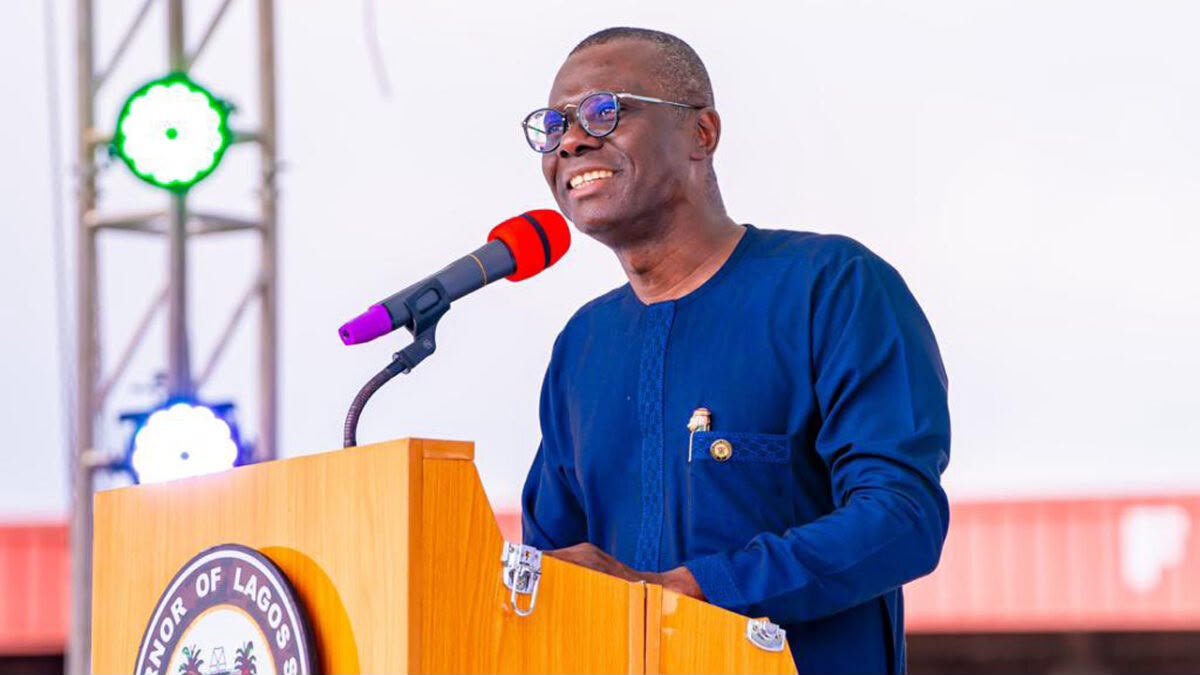
Sanwo-Olu made the call on Tuesday while delivering the centenary anniversary lecture of the Yoruba Tennis Club at its headquarters in Onikan, Lagos.
The lecture, titled “Democracy, Governance and the Lagos Spirit: A Century of Excellence,” was attended by the First Lady of Lagos State, Dr. Ibijoke Sanwo-Olu; Deputy Governor and APC governorship candidate, Dr. Obafemi Hamzat; public officials, traditional rulers, political leaders, members of the club and other dignitaries.
The Governor, who also serves as the South-West Zonal Coordinator of the APC Presidential Campaign Council, said Lagos had experienced the benefits of policy continuity and should not abandon proven development strategies for untested alternatives.
He said the same principle applied at the national level, where President Bola Ahmed Tinubu is seeking re-election on the APC platform.
Sanwo-Olu said the gains of Tinubu’s reforms were becoming visible in areas including foreign exchange stability, education, agriculture and security.
“Our challenge to the opposition remains the same, to put forward credible ideas that are able to compete with ours, instead of seeking change for the sake of change,” he said.
The Governor described the “Lagos Spirit” as a combination of courage, self-reliance, openness and a commitment to continuous improvement. He said these qualities had shaped the state’s democratic culture, governance and development.
According to him, Lagos has repeatedly responded to exclusion and adversity by creating its own opportunities and institutions.
He recalled the city’s role in the June 12 pro-democracy struggle, the development of indigenous political institutions and its long history of civic activism.
Sanwo-Olu said Lagos’s development since the restoration of democracy in 1999 had been driven by continuity, with successive administrations building on the development blueprint initiated under former Governor Bola Tinubu.
He identified four principles as the foundation of what he called the “Lagos Playbook” for governance: vision, self-reliance, partnership and measuring government by its impact on ordinary citizens.
On vision, he said Lagos developed a long-term blueprint after the return of democracy in 1999, and successive administrations had continued to implement it.
He cited the state’s Blue and Red rail lines as examples of projects made possible by policy continuity, describing them as the first rail services built and operated by a sub-national government in Nigeria.
Sanwo-Olu said self-reliance had also been central to Lagos’s progress. He recalled how the state responded to the withholding of its federal allocation by reforming its tax administration and strengthening its internally generated revenue.
According to him, Lagos now generates more revenue internally than any other state in Nigeria.
On partnership, he said the founders of the Yoruba Tennis Club demonstrated the value of collective effort by raising funds and securing land to establish their own institution during the colonial era.
The fourth principle, he explained, was the belief that the effectiveness of governance should be judged by how it improves the lives of ordinary residents.
He said the relevant questions were whether medical workers could reach their workplaces on time, whether children had desks and learning materials, whether traders could transport goods before they spoiled and whether transport workers earned enough to support their families.
Assessing his administration’s performance over the past seven years, Sanwo-Olu said the THEMES Plus development agenda had produced improvements in transport, health, the environment, education, technology, the economy, tourism, entertainment, security and governance.
He said the administration had established two public universities and built one of Africa’s largest rice mills at Imota.
He added that Lagos had attracted hundreds of millions of dollars in investments in submarine cable landings and data centres, creating the foundation for expanded digital infrastructure.
Sanwo-Olu also said the state was building West Africa’s largest children’s hospital and introducing digital technology into public-school classrooms.
He disclosed that the government was developing the Lagos Central Food Security System and Logistics Hub at Ketu-Ereyun to support the state’s food market, which he valued at ₦5.89 trillion annually.
The project, he said, would modernise the aggregation, storage, processing and distribution of food in Lagos despite the state’s limited land space.
Reflecting on the history of the Yoruba Tennis Club, Sanwo-Olu said its establishment represented a bold response by indigenous Lagosians to racial segregation in colonial-era Lagos.
He urged the club to preserve its founding values while adapting to changing times. He also called for greater youth inclusion, better documentation of the club’s history and high standards in admitting new members.
The Chairman of the Yoruba Tennis Club, Chief Olawunmi Gasper, reaffirmed the organisation’s commitment to preserving cultural heritage, promoting fellowship and contributing to Lagos’s social, economic and civic development.
Gasper described Sanwo-Olu as a progressive leader, public-sector reformer and advocate of people-centred development.
He commended the administration’s infrastructure and development initiatives, saying the anniversary lecture provided an opportunity to examine the relationship between democracy, governance and Lagos’s growth.
The centenary celebration also featured the presentation and launch of the club’s anniversary history book, the groundbreaking ceremony for a proposed Legacy Building and an exhibition of historical and archival materials documenting the organisation’s 100-year history.