

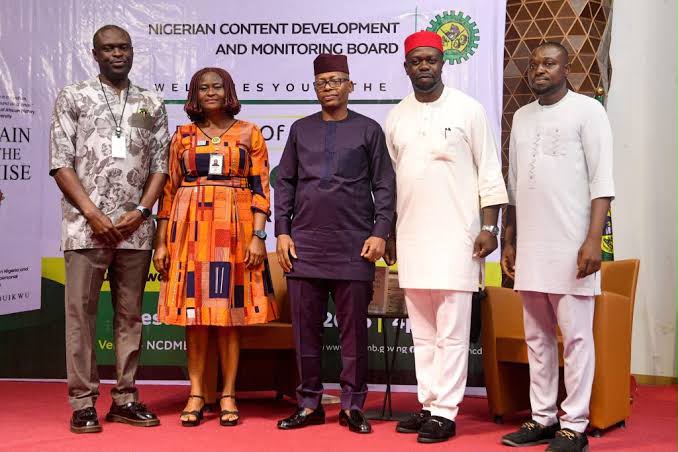
By Vera Osokpo
The Nigerian Union of Journalists, the Nigerian Institute of Public Relations and the Association of Nigerian Authors have supported the fifth edition of the Nigerian Content Development and Monitoring Board’s Book Reading Programme in Yenagoa, Bayelsa State.
The event brought together writers, journalists, public-relations professionals, academics and university students for discussions on literature, journalism, public affairs and national development.
The featured guest was veteran journalist and strategic communication expert Paul C. Nwabuikwu, who presented his 2025 book, *The Pain and the Promise: Insights and Fragments on Nigeria and People, Public and Personal (1990–2025)*.
Selected passages from the book were read during the programme, followed by question-and-answer sessions that explored Nigeria’s political history, journalism, creative writing and the country’s prospects for the future.
Addressing participants, NCDMB Executive Secretary Felix Omatsola Ogbe, who was represented by the General Manager of the Corporate Communications Division, Obinna Ezeobi, said the programme reflected the board’s commitment to promoting reading, learning and the continuous exchange of ideas.
He said books allowed people to learn from the experiences of others and examine important issues from different perspectives. According to him, the quarterly programme was designed to create meaningful conversations between authors, thought leaders and the wider public.
Ogbe explained that the NCDMB’s mandate extended beyond the oil and gas industry to include capacity building and the development of citizens’ intellectual abilities.
He said the board supported businesses, strengthened institutions, created opportunities for Nigerians to participate in the energy sector and encouraged the development of thought and knowledge.
The executive secretary stressed that human-capital development should not be limited to technical and professional training. He urged Nigerians to read widely, think critically and build a stronger culture of learning.
Speaking about his work, Nwabuikwu said his experience as a newspaper columnist had shaped his determination to provide greater depth and context in his writing.
“Journalism is the first draft of history,” he said, explaining that he sought to analyse events in a way that helped readers understand their broader significance.
He said the book was largely a response to events that occurred between 1990 and 2025. Among the issues he discussed was Nigeria’s costly military intervention in Liberia and Sierra Leone through the Economic Community of West African States Monitoring Group.
Nwabuikwu described the intervention as particularly troubling because, in his view, Nigeria did not secure a significant strategic benefit from the expenditure. He referred to a 1999 statement by former President Olusegun Obasanjo that Nigeria had spent $8 billion sponsoring ECOMOG operations.
Explaining the book’s title, he said Nigerians faced significant difficulties in their daily lives, but the country continued to possess considerable promise.
Nwabuikwu also discussed his use of humour in political and social commentary. He described humour as an “escape valve” that allowed writers to make serious points under restrictive political conditions without unnecessarily provoking those in power.
Asked how aspiring writers should approach creative writing, he advised them to remain authentic and avoid imitating other writers. He encouraged writers to focus on subjects that genuinely interested them and to write about issues they were passionate about.
The NCDMB hosted the first edition of the Book Reading Programme in August 2024, featuring Leadership Newspapers’ Senior Vice Chairman and Editor-in-Chief, Azu Ishiekwene.
The second edition, held on 25 August 2025, featured former *PUNCH* Editor Dayo Oketola. Subsequent editions featured King Bubaraye Dakolo, Agada IV, in November 2025, and former House of Representatives member Dakuku Peterside in April 2026.
The programme is intended to promote reading and literacy, encourage critical thinking and strengthen intellectual engagement among authors, academics, students, media professionals and members of the public.