

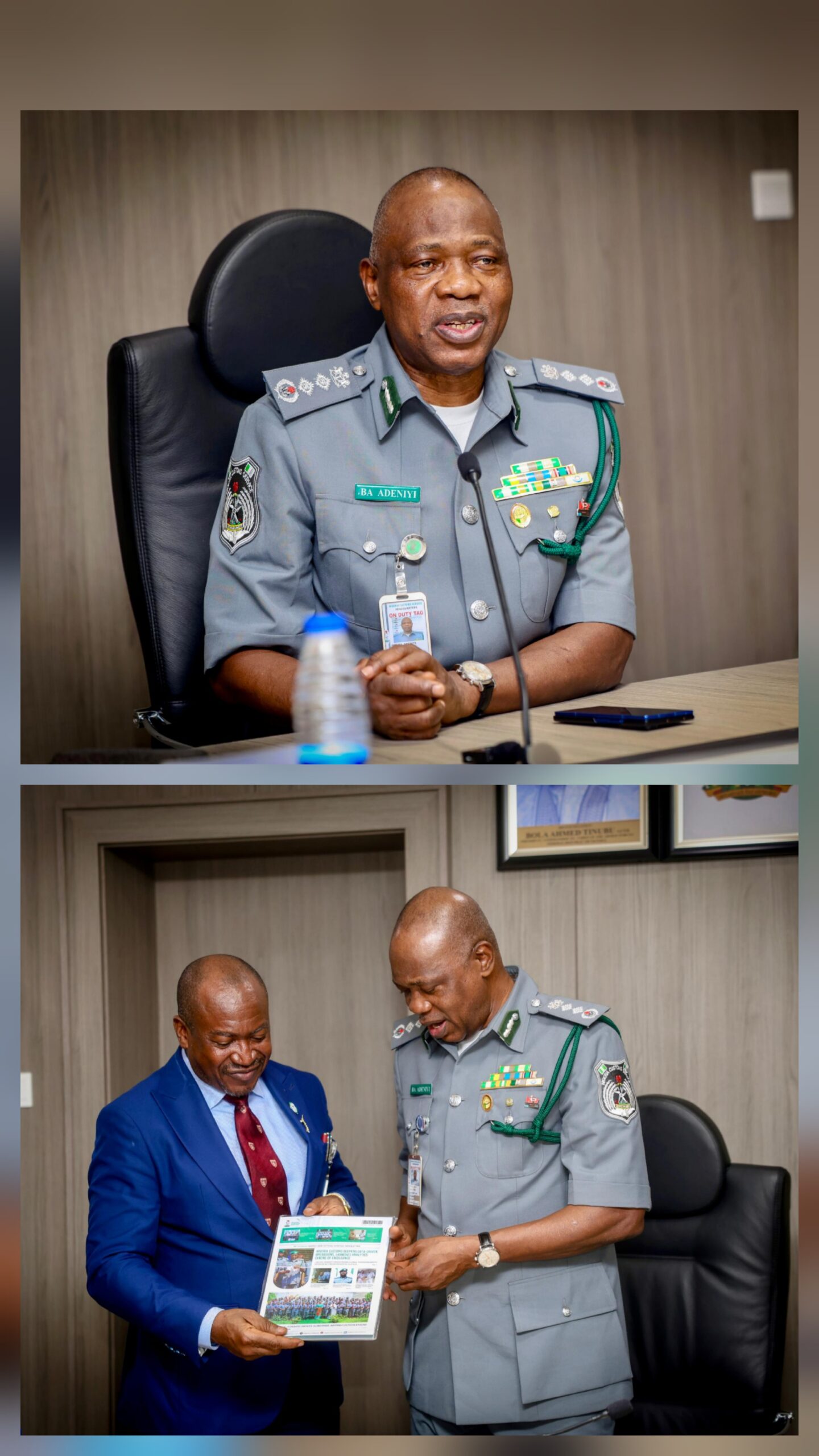
The Comptroller-General of Customs, Adewale Adeniyi, has pledged to deepen the institutional partnership between the Nigeria Customs Service and Yakubu Gowon University (formerly University of Abuja) as part of efforts to strengthen learning, research, and student development. The commitment was made at the Customs Headquarters in Maitama, Abuja, on Tuesday, 5 May 2026, during a courtesy visit by the Vice‑Chancellor, Professor Hakeem Fawehinmi, and the university’s leadership team.
CGC Adeniyi traced the roots of the relationship to his earlier tenure as Commandant of the Nigeria Customs Command and Staff College, when the Service and the university first moved to formalise a partnership through a Memorandum of Understanding. He recalled that the process advanced far but was interrupted by leadership changes on both sides. Despite the delay, Customs has continued to support the university through targeted interventions, including the provision of a 32‑seater bus for mass transit and the establishment of a fully equipped computer centre with close to one hundred workstations.
The Comptroller‑General said the Customs Service is now ready to review the new proposals presented by the university and to prioritise initiatives that will deliver tangible impact on teaching, research, and campus life. “For us, beyond legacy, what matters most is impact,” he said, adding that the Service understands the challenges faced by Nigerian universities, particularly in transportation, infrastructure, and digital capacity. He proposed a phased implementation model, where priority projects are addressed first, with the possibility of scaling up collaboration over time.
Adeniyi also underscored the importance of having a university in the nation’s capital that reflects the stature of the Federal Capital Territory. He expressed willingness to support the growth of Yakubu Gowon University as a key institution in Abuja, capable of producing high‑calibre graduates and thought leadership for the country.
Professor Fawehinmi, in his remarks, commended the leadership of the Comptroller‑General and the role of the Nigeria Customs Service in national development and governance reforms. He described the visit as an opportunity to reinforce the mutual relationship while exploring new areas of strategic partnership. With a student population of nearly 40,000, he said the university is grappling with rising demands for transport, infrastructure, and technology support.
The Vice‑Chancellor identified mass transit, ICT infrastructure, research facilities, and professional training as key areas where Customs input would be welcome. He also highlighted the university’s Centre for Defence and Migration Studies as a potential hub for collaboration on border management, migration research, executive training, and national security analysis.
Both sides agreed that any partnership should be structured to maximise benefit for young Nigerians and the broader society, with the Customs Service and the university positioned as complementary actors in education, security, and national development.