

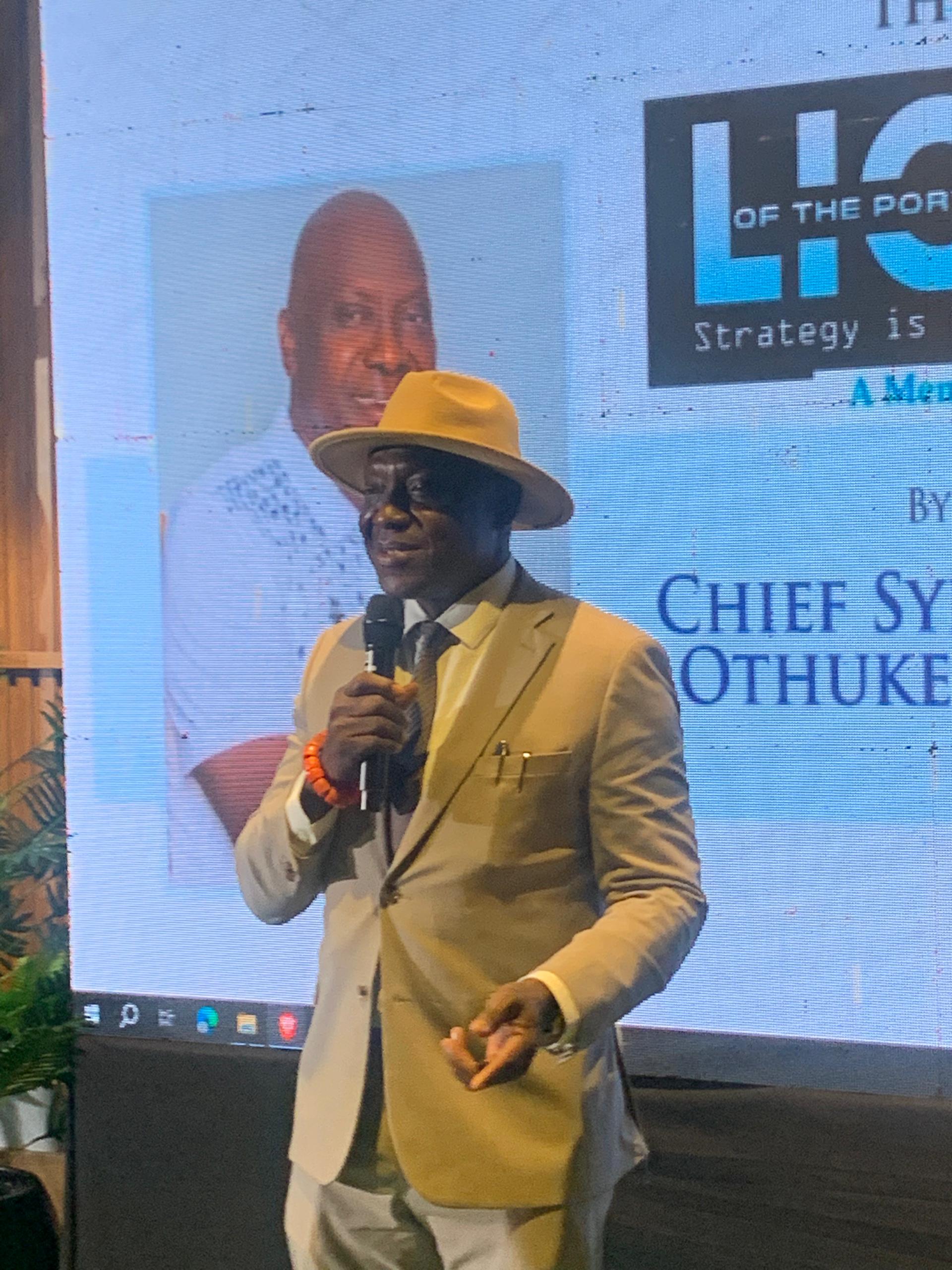
Chief Sylvester Othuke Egede, former Port Manager of Tin Can Island Port, has presented his memoir, “Lion of the Port Corridor: Strategy Is Everything,” offering a rare inside account of the thinking and leadership approach that ended the persistent Mile Two/Tin Can port corridor traffic congestion.
At the book presentation, Egede explained that the memoir draws heavily from his early years in office, a period marked by severe gridlock caused largely by indiscriminate truck parking along the port access roads. He recalled that, unlike previous interventions that relied on force and produced limited results, the eventual resolution was achieved through deliberate engagement, patience, and well-defined strategy.
Egede noted that the turning point came when port authorities chose dialogue over confrontation, engaging truck operators and other stakeholders to understand their concerns. By applying a SWOT framework carefully examining the strengths, weaknesses, opportunities, and threats surrounding the situation his team was able to design a practical and sustainable solution. Truckers, he said, willingly cleared the corridor after mutually agreeing on a timeline and receiving assurances that an alternative truck holding facility would be provided.
He revealed that a suitable site, with the capacity to accommodate roughly 4,000 trucks, has since been identified through collaboration with key stakeholders. According to him, the experience underscores the importance of looking beyond symptoms to address the real causes of entrenched problems. The memoir, he added, captures lessons from his years at the Nigerian Ports Authority, reinforcing the message that sound strategy, critical thinking, and insight remain indispensable tools for effective governance.
Speaking at the event, former President of the Ship Owners Association of Nigeria (SOAN), Dr. MKGeorge Oyung, underscored the vital role of port corridors in global commerce. He described the port corridor as a seamless chain of transport infrastructure and services that enables goods to move efficiently from seaports to markets and households, famously summarizing its importance with the phrase, “No shipping, no shopping.”
Dr. Oyung highlighted the central role of seafarers in sustaining international trade, noting that close to 90 percent of world trade is carried by sea and supported by about 1.9 million seafarers worldwide. He praised their resilience, particularly during the COVID-19 pandemic, and drew attention to the hardships faced by seafarers operating in conflict zones, including Ukraine. He also acknowledged the growing, though still limited, presence of women in the maritime profession, commending their courage and contribution.
Emphasizing the economic value of maritime transport, Oyung pointed out that a single large vessel can move cargo equivalent to thousands of trucks or hundreds of rail wagons, making sea transport more efficient, safer, and environmentally sustainable. He stressed that Nigeria’s strategic position in the post-Panama Canal shipping landscape places a premium on efficient port corridors, noting that smooth port operations are essential for competitiveness within the global ocean economy, now regarded as one of the world’s largest economic spheres.