

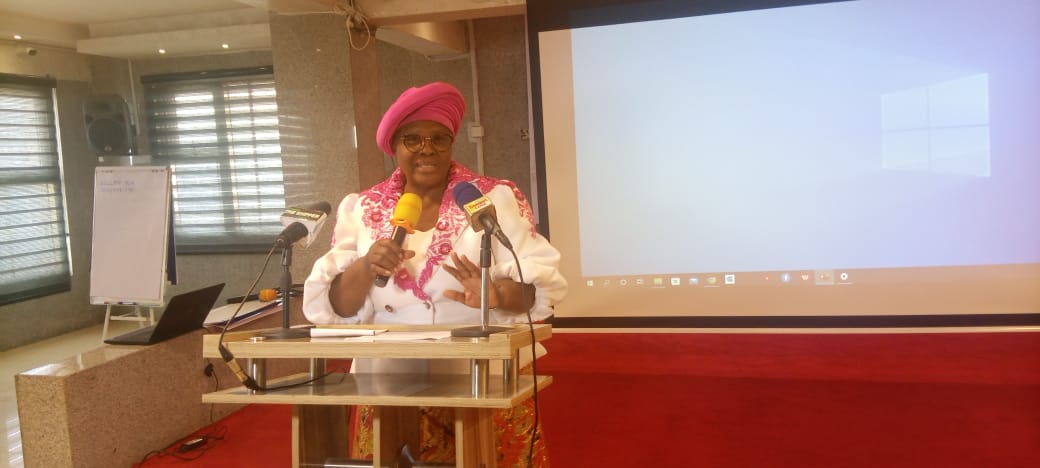
The President of the League of Maritime Editors has called for urgent attention to the imbalance in cargo distribution between Lagos and eastern ports, while also urging authorities to tackle pollution and waste in Nigeria’s coastal waters as part of efforts to unlock the full potential of the nation’s marine and blue economy.
Speaking at the opening ceremony of the League’s annual general meeting and conference in Lagos, the President said the event was organised with the primary objective of setting the agenda for policymakers, informing the public, and educating citizens on critical issues affecting the maritime sector.
“Today’s conference is therefore part of this effort as journalists to do the needful in the area of agenda-setting. I wish to expressly state that organising this conference again is solely towards nation-building. The discussion needs to be held, not to bring any one administration down, but to identify our gaps, spotlight the opportunities, and share the lessons learned,” he said.
He noted that certain new priorities for members of the League of Maritime Editors are the Lagos and Eastern Ports, acknowledging that while Lagos ports need attention, the eastern ports also require urgent intervention to reverse the current imbalance in cargo vessel calls.
“This is why this year’s conference is titled ‘Lagos to Eastern Ports: How to Reverse a Systemic Imbalance in Cargo Vessel Calls.’ Some papers our chairman can deviate a bit, but everything is geared towards the best for the industry. Indeed, the time has come for us as citizens of our great country to focus on how to enhance the potential inherent in our marine and blue economy,” he stated.
The President pointed to the enormous potential along the coastline, citing the exo-primal stretching from Abraka to Ekumu, down to Sapele and beyond in Delta State, with vast tourism and agro-fishery potential, same with Bayelsa and other coastal states.
“I’m calling on us all to focus on strategies that can help us reverse the imbalance in cargo ports, not that the western ports are not a joint comparative advantage and increasing the nation’s gross domestic earning, but can we also spread cargo to the eastern ports in the drive to boost the nation, to boost the economy of the eastern ports, and by extension, the other coastal states,” he said.
“That is to me, the key for the marine and blue economy ministries to critically look into, and that, in turn, will further increase agro-domestic earning, thereby improving the nation’s economic potential.”
Once again, on behalf of the League, he encouraged the nation, particularly the Ministry of Marine and Blue Economy, to prioritise the mapping out of the nation’s coastal areas and develop the major seaports around them.
Similarly, he called on the leadership and authorities on the beach to look into pollution and waste in the coastal state corridor. “This is very important because studies have shown that there is a high rate of chemical contamination in the marine and freshwater fish in Nigeria. This affects our coastal nation and neighboring states who consume fish and water, including reproductive disorder in adults and other overwhelming health challenges that drain our families of their earned income,” he said.
Moreover, he said it goes without saying that pollution also has an equally devastating effect on the export potential of marine products. “This conference should therefore be able to highlight issues and solutions around pollution of our territorial waters, the port system within the context of the national ecological dynamics, the noise, vessels, and so on,” he stated.
He noted that some of the agencies under the leadership of the Ministry of Marine and Blue Economy would present position papers, including the Nigerian Ports Authority, Nigerian Maritime Administration and Safety Agency, Nigerian Shippers’ Council, and the Nigerian Customs Service.
“I am keen to hear the insights from those papers and perhaps discussion about them. We all have a responsibility to make our country great. After all, there was a time when Nigeria was on par with Asian tigers in the not-too-distant past. The good news is that we already have natural and human resources to reverse the trend,” he said.
The President expressed hope that the conference would resonate with all participants and lead to new agendas being set for the growth of the marine and blue economy and Nigeria at large.
Finally, he thanked the Nigerian Ports Authority, the Nigerian Shippers’ Council, the Nigerian Maritime Administration and Safety Agency, the Nigerian Customs Service and the Seafarers’ Union of Nigeria for their support and for making the conference a success.