

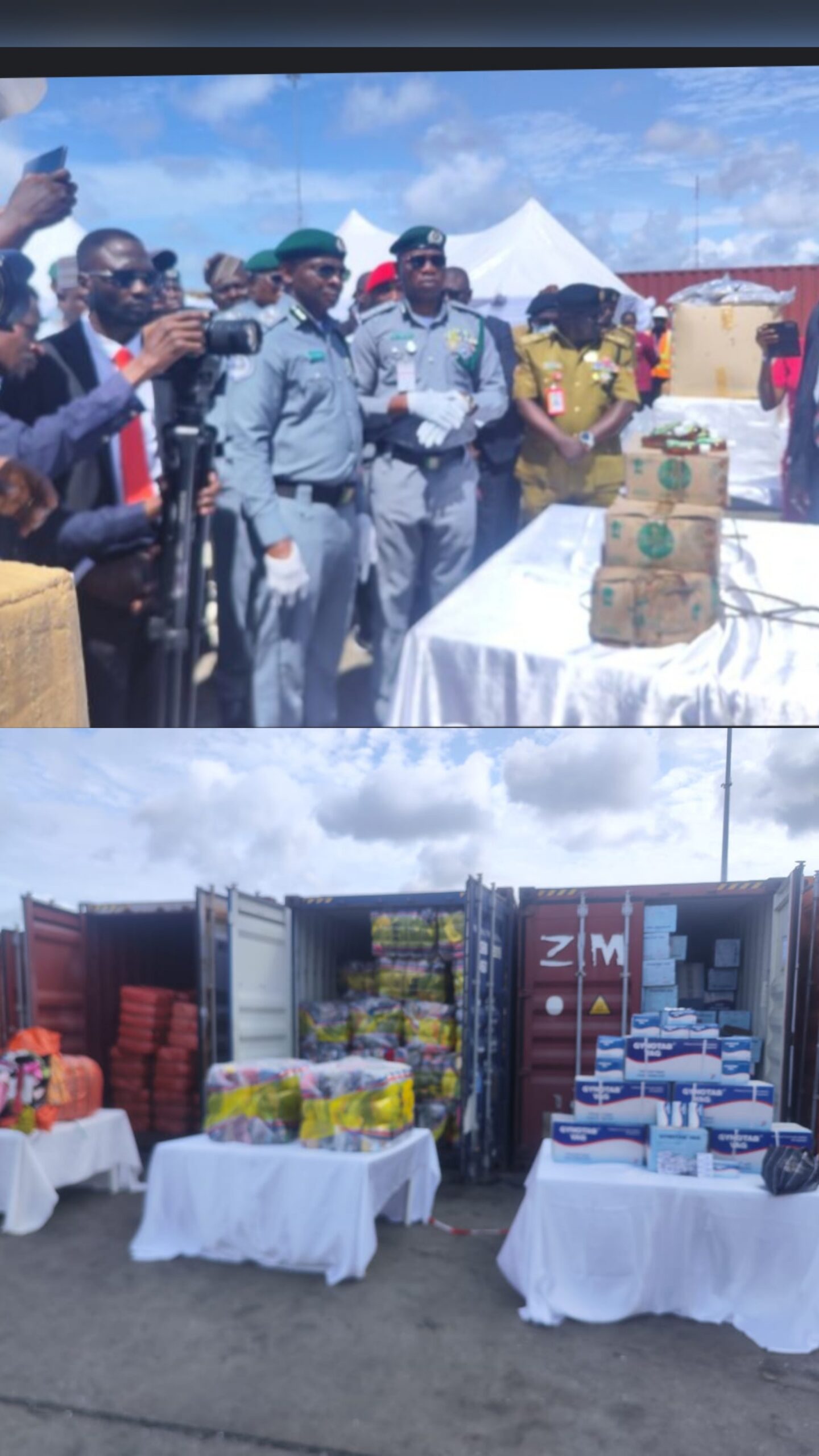
The Nigeria Customs Service (NCS) has handed over seized cannabis sativa, codeine syrup and expired goods worth N43.59 billion to the National Drug Law Enforcement Agency (NDLEA) and the National Agency for Food and Drug Administration and Control (NAFDAC) following the interception of 13 containers at the Apapa Port in Lagos.
The Comptroller-General of Customs, Bashir Adewale Adeniyi, during a press briefing at the APM Terminals in Apapa on Thursday, said the seizures were the outcome of sustained intelligence-led operations involving cargo profiling, documentary scrutiny and targeted examination.
The 13 containers contained cannabis sativa, codeine syrup, security-sensitive equipment, used clothing and expired products, with a combined duty paid value of N43,588,618,859.
Three containers were laden with a total of 15,245 parcels of cannabis sativa weighing 7,624kg, equivalent to more than 7.6 tonnes. Another 40-foot container contained 1,700 cartons of codeine syrup comprising 169,998 bottles, concealed beneath household items.
The Service also intercepted five containers loaded with expired tomato ketchup, antiseptic liquid, vaginal tablets and disposable nappies.
“The cannabis interceptions are the product of inter-agency work with the National Drug Law Enforcement Agency, supported by credible intelligence from international security partners”, Adeniyi said.
The CGC said the Service had strengthened cargo profiling and risk assessment across its commands, while deploying the B’Odogwu platform to bring trade data into the assessment process.
He also disclosed that the Service established an INTERPOL Data Centre at its headquarters in Abuja in July, giving officers access to more than 152 international databases.
According to him, Customs has also deepened operational cooperation with the NDLEA, NAFDAC, the Office of the National Security Adviser and international security partners.
On the 108 high-definition dual-camera drones extracted from one of the containers, Adeniyi said while drones have legitimate uses, equipment of that nature could become a means of surveillance, reconnaissance and delivery in the wrong hands.
“Restricted and security sensitive equipment requires the appropriate security approvals, end-user certificates and documentation before clearance. Consignments of that character that arrive without them will be detained.”
He warned that Nigerian ports would not be allowed to serve as channels through which security-sensitive capabilities reach persons working against the country’s security
Another 40-foot container contained 1,700 cartons of codeine syrup comprising 169,998 bottles, concealed beneath household items were seized.
The Service also intercepted five containers loaded with expired tomato ketchup, antiseptic liquid, vaginal tablets and disposable nappies.
“The cannabis interceptions are the product of inter-agency work with the National Drug Law Enforcement Agency, supported by credible intelligence from international security partners”, Adeniyi said.
The CGC said the Service had strengthened cargo profiling and risk assessment across its commands, while deploying the B’Odogwu platform to bring trade data into the assessment process.
“Restricted and security sensitive equipment requires the appropriate security approvals, end-user certificates and documentation before clearance. Consignments of that character that arrive without them will be detained.”
He warned that Nigerian ports would not be allowed to serve as channels through which security-sensitive capabilities reach persons working against the country’s security.
Adeniyi said the importation of expired products also posed a risk to consumers, particularly children and women.
“These are products applied to the body and consumed by households.
Their importation after expiry places children, women and other consumers at risk of harm they have no means of detecting at the point of purchase.”
He assured legitimate businesses that the Service would continue to facilitate the quick movement of lawful trade, stressing that scrutiny would focus on consignments, transactions and operators that present identifiable risks.
The CGC warned that no port, border station or logistics channel would be allowed to serve as a safe haven for false declaration, concealment, undervaluation or the importation of prohibited goods.
He urged importers who are uncertain about the treatment of a product to use the Service’s Advance Ruling mechanism to obtain its position on classification, valuation and origin before shipment.
He also encouraged operators with a sustained record of compliance to join the Authorised Economic Operator programme, which he said offers more predictable clearance and fewer interventions where risk assessment justifies it.
Meanwhile, the Controller, Apapa Area Command, Comptroller Emmanuel Oshoba, said the command will continue to prioritise effective leadership, operational excellence, collaboration and public accountability.
Oshoba reaffirmed the command’s commitment to professionalism, discipline, integrity and diligence in the discharge of its statutory responsibilities, while supporting initiatives aimed at facilitating legitimate trade and safeguarding Nigeria’s national interest.