

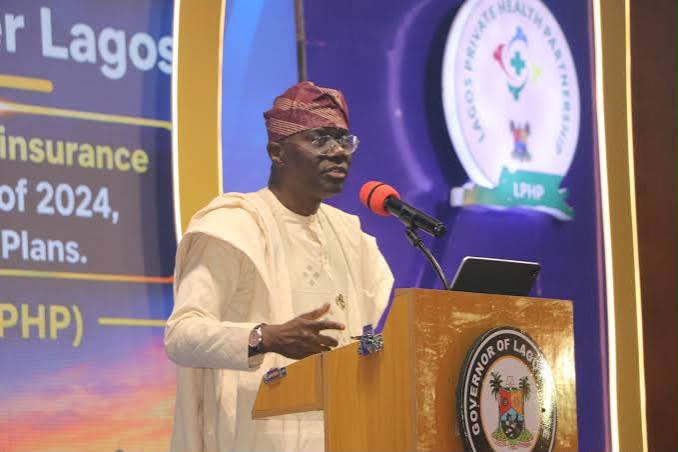
Lagos State Governor Babajide Sanwo-Olu has launched the enforcement of mandatory health insurance in the state under Executive Order EO/BOS/01 of 2024, requiring residents, employers and workers to obtain health coverage.
The Governor also unveiled the Lagos Private Health Plans (LPHP), which will extend insurance coverage to salaried workers and corporate organisations, complementing the existing Ilera Eko scheme for vulnerable residents and the informal sector.
Sanwo-Olu gave residents until December 31, 2026, to obtain health insurance, with enforcement beginning on January 1, 2027.
He announced the measures at an event in Victoria Island, attended by government officials, health practitioners and public- and private-sector stakeholders, under the theme “Lagos covered, a shared commitment, a healthier Lagos.”
The Governor said the objective of the Executive Order was not merely enforcement, but ensuring that every Lagos resident could access quality healthcare without facing financial hardship.
He explained that the order assigns responsibilities to individuals, employers and government, making social health insurance compulsory across the state.
While Ilera Eko covers vulnerable residents and informal-sector participants, the new private health plans are designed to meet the needs of salaried employees and employers.
Sanwo-Olu said employers should treat workers’ healthcare as a necessary business cost, alongside pensions and other employment-related obligations.
He also directed that no healthcare provider should deny emergency care to residents because of payment or insurance concerns, adding that patients must first be stabilised before financial issues are addressed.
The Governor disclosed that 21 health maintenance organisations had endorsed participation in the new plans, describing the arrangement as a partnership between government and private operators to expand coverage and improve healthcare delivery.
He urged Nigerian medical professionals considering emigration to reconsider, arguing that improved healthcare financing could make the sector more sustainable for practitioners.
Lagos State Commissioner for Health, Prof. Akin Abayomi, said advances in medical technology, including artificial intelligence, robotics and modern diagnostics, had significantly raised the cost of healthcare delivery.
He said a strong and inclusive health insurance system was necessary to protect residents from rising medical costs while improving access to quality services.
Abayomi described the launch as a major shift in healthcare financing, noting that reliance on out-of-pocket payments placed excessive financial pressure on households and health facilities.
Earlier, Chairman of the Lagos State Health Management Agency (LASHMA), Dr. Adebayo Adedewe, said the state had increased its Health Equity Fund from ₦1 billion to ₦3 billion.
He said the fund would provide insurance coverage for more than 500,000 vulnerable residents who cannot afford premiums.
Adedewe added that LASHMA would expand enrolment, strengthen public awareness and ensure the policy translates into accessible healthcare.
He said the agency had intensified community engagement through radio campaigns, billboards, digital advocacy and partnerships with traditional rulers, market associations, transport unions and other grassroots organisations.