

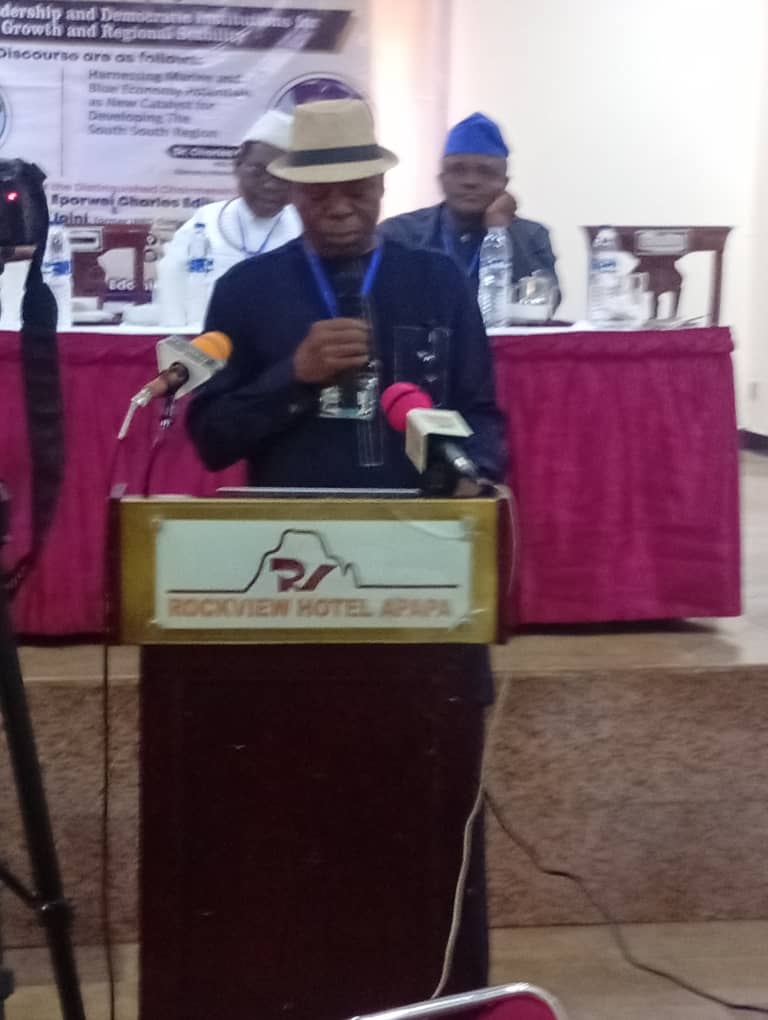
The Managing Director and Chief Executive Officer of Kamany Services Limited, Dr. Charles Okorefe, has tasked State governors in the South-South region to harness its marine and Blue Economy potentials as alternative drivers of economic growth, employment generation and sustainable development.
Dr. Charles Okorefe presented his paper on the Blue Economy at the 20th anniversary public lecture of South-South International Magazine, held at Rockview Hotel, Apapa, Lagos, on November 18, 2026.
Okorefe said while presenting a paper titled “Harnessing Marine and Blue Economy Potentials as New Catalyst for Developing the South-South Region of Nigeria.
He described the Blue Economy as a development model that promotes the sustainable use of marine and coastal resources while protecting aquatic ecosystems and creating economic opportunities.
He explained that the concept covers economic activities connected with oceans, seas, coastal areas, rivers and lakes, including fisheries and aquaculture, tourism, maritime transportation, shipping, port operations, renewable energy and marine biotechnology.
Tracing the evolution of the concept, Okorefe referred to the work of Belgian scholar and entrepreneur Gunter Pauli and highlighted the 2012 United Nations Conference on Sustainable Development, popularly known as Rio+20, and its outcome document, ‘The Future We Want.”
He also linked the Blue Economy to the Sustainable Development Goals, particularly Goal 14, which focuses on conserving and sustainably using oceans, seas and marine resources.
Reflecting on the Niger Delta’s history, he recalled the region’s early commercial importance, including the activities of the Royal Niger Company and foreign commercial interests such as the United Africa Company, John Holt, Unilever and G.B. Ollivant between 1879 and 1886.
He also highlighted the historical importance of coastal trading centres and harbours in Calabar, Opobo, Brass, Burutu and Warri, as well as the establishment of Southern Nigeria Marine in 1906.
Okorefe traced the development of the modern oil industry in the region to the discovery of commercial crude oil at Oloibiri in 1956, with production and export activities commencing in 1958.
However, he observed that oil exploration and production have contributed to environmental degradation, communal tensions and conflicts in the Niger Delta.
He argued that the region must diversify beyond crude oil by investing in fisheries and aquaculture, marine biotechnology, renewable energy, coastal tourism, dredging, marine support services, port development, ship recycling and inland waterways transportation.
Other areas he identified for investment include maritime safety, marine insurance and shoreline protection.
Okorefe identified low public awareness, marine pollution, weak governance, inadequate investment, exclusion of local communities, overfishing, climate change, rising sea levels and research limitations as major challenges to developing the Blue Economy.
To address these challenges, he called for public enlightenment, professional training, improved waste management, pollution control, stronger legal frameworks and integrated ocean governance.
He also advocated community participation, support for small-scale fish merchants and mangrove conservation groups, sustainable fishing practices, climate adaptation and increased investment in marine technology and renewable energy.
The speaker urged South-South governors to develop a regional Blue Economy investment blueprint, invest in human capital and create an enabling environment for private-sector participation.
He recommended public-private partnerships and the use of Blue Bonds to finance the protection of mangroves, coral reefs and marine protected areas, citing Seychelles’ $15 million Blue Bond initiative as an example.
Other proposals included the development of aquaculture and fish-port clusters, a regional climate strategy, marine-based power generation and an integrated transport blueprint linking roads, railways, inland waterways and pipelines.
He further called for stronger export capacity through value addition, modern infrastructure and efficient logistics, urging governments to collaborate with investors and local communities to unlock the region’s marine and coastal economic potential.
MD Okorefe expressed optimism that greater commitment by federal and regional governments to the Blue Economy would stimulate economic growth, create employment opportunities and promote sustainable development across the South-South region.