

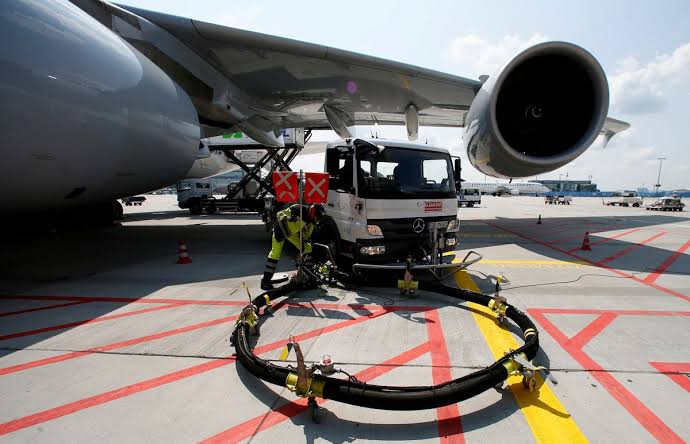
Global airlines are struggling to secure enough jet fuel to maintain regular flight schedules as the prolonged closure of the Strait of Hormuz continues to disrupt energy trade and tighten supply worldwide.
The months-long shutdown of the strategic waterway, which normally carries about 20 per cent of the world’s oil and a large share of jet fuel exports, has led to severe fuel shortages in several regions, forcing carriers to cut flights, add refuelling stops and raise fares.
The U.S.–Israeli military campaign against Iran triggered the closure of the strait, a key corridor linking the Persian Gulf with the Gulf of Oman and the Arabian Sea. Several months of restricted or halted traffic have significantly reduced energy exports from the Middle East, with many countries now facing tight fuel markets.
In July, several European airlines warned they were at risk of running out of jet fuel. Europe has turned to the United States, Nigeria, Canada, India and South Korea for alternative supplies, but the region continues to feel the strain. The United Kingdom, France and Germany are particularly exposed because of their heavy historical reliance on Middle Eastern jet fuel imports.
In recent decades, several European countries have reduced refining capacity in favour of a green transition, leaving them more vulnerable to supply chain disruptions. Before the war, Europe relied on the Middle East for roughly half of its jet fuel imports. Iran has allowed limited fuel shipments through the strait, but it remains unclear when normal trade will resume.
On 18 June, consultancy Energy Aspects forecast a jet fuel supply deficit across Europe of almost 600,000 barrels per day in the third quarter of 2026, compared with surpluses of around 116,000 bpd in the United States and 425,000 bpd in the Asia-Pacific region. Europe’s inventories stood at about 38 million barrels at the beginning of June, equivalent to roughly 30 days of demand, according to the firm and the International Energy Agency (IEA).
EU Energy Commissioner Dan Jorgensen said the region could face jet fuel shortages towards the end of the summer season, but that Brussels planned to coordinate releases of national reserves as required. Several European countries have also sought alternative suppliers to fill the gap.
Jet fuel prices have been highly volatile since the strait was closed, rising to a high of $215.32 a barrel at the end of March before falling to just over $130 a barrel. Because jet fuel accounts for about 20 to 25 per cent of an airline’s operating costs, keeping ticket prices down has become difficult. Some carriers have already been forced to cut flights.
Irish low-cost carrier Ryanair said about 20 per cent of its unhedged fuel was hit hard by price spikes, pushing operating costs up by 11 per cent. The airline’s jet fuel for 2027 is 80 per cent hedged at $67 per barrel, and 15 per cent hedged for 2028 at $85 per barrel. Chief Executive Michael O’Leary said the company’s conservative hedging strategy has helped it remain resilient to rising prices.
In the United States, Southwest Airlines has taken innovative steps to secure supplies, including shipping jet fuel from Texas to California via the Panama Canal in the spring. The shipment brought about a week’s supply to the West Coast at a time when supply was most constrained, transporting 12.6 million gallons from Houston to Los Angeles.
California remains more dependent on fuel imports than other parts of the U.S., making it more vulnerable to global shortages. Southwest reported in July that its fuel expenses were almost $900 million higher in the second quarter compared with the same period last year.
Several U.S. airlines have reduced or abandoned jet fuel price hedging in recent years, encouraged by abundant domestic supply and expanded refining activity. This has left some carriers more exposed to extreme price volatility. In mid-July, United Airlines said it expects nearly $6 billion in additional fuel expense for the full year 2026 compared with its earlier forecast.
Airlines are staying afloat by turning to alternative jet fuel suppliers as global supplies remain constrained, but this has driven up prices in recent months. While the approach has worked so far, it is uncertain how long carriers can sustain it. Countries with limited refining capacity are expected to be disproportionately affected if the Hormuz disruption persists.