

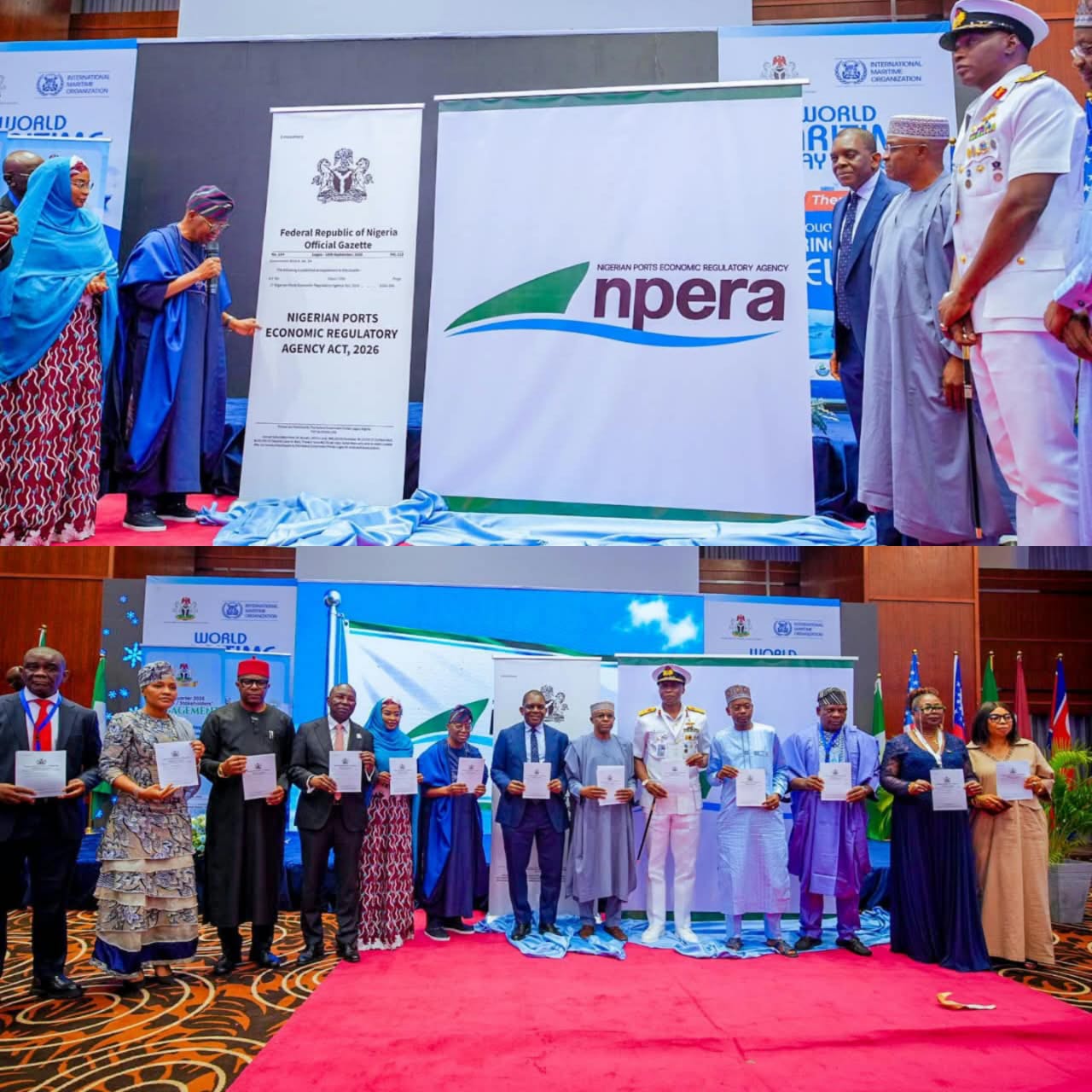
The Federal Government has unveiled the newly gazetted Nigeria Ports Economic Regulatory Agency (NPERA) Act, 2026, alongside the agency’s official logo, marking a new phase in port economic regulation, investor confidence and Nigeria’s maritime competitiveness.
The development was announced by the Minister of Marine and Blue Economy at the ministry’s third-quarter stakeholders’ and citizens’ engagement held in Lagos.
The NPERA Act followed the assent of President Bola Ahmed Tinubu in June 2026. The minister said he had directed the immediate constitution of a ministerial committee to oversee the transition of the Nigerian Shippers’ Council into NPERA.
He said the committee’s mandate is to ensure that the new regulatory agency operates independently, impartially and transparently, while providing a clear framework for economic regulation in the port sector.
The transition is expected to strengthen oversight of port charges, service standards, competition and commercial practices across Nigeria’s seaports, with the aim of improving efficiency and protecting the interests of port users, investors and operators.
The minister also disclosed that the government is modernising the Apapa, Tin Can Island, Onne, Rivers, Delta and Calabar ports. In addition, six deep seaports are being developed in Ibom, Bakassi, Agge, Gateway, Ondo and Bonny.
According to him, the port modernisation and deep seaport projects are intended to expand national cargo-handling capacity, reduce congestion, improve logistics efficiency and strengthen Nigeria’s position as a regional maritime and trade hub.
He highlighted recent gains in maritime security, including zero piracy incidents in Nigeria’s territorial waters. He also noted the lifting of the U.S. Coast Guard’s 12-year Condition of Entry restrictions in August 2026, describing the development as evidence of improved safety and compliance in Nigerian shipping.
The minister said the government is accelerating access to the Cabotage Vessel Financing Fund for qualified indigenous operators. The fund is designed to support Nigerian-owned vessels and strengthen local participation in coastal shipping and maritime services.
He added that Nigeria is strengthening strategic partnerships with countries including Denmark, India, Norway and the United Kingdom to deepen technical cooperation, attract investment and support capacity development in the marine and blue economy.
The minister reaffirmed the government’s commitment to building a transparent, competitive and investment-friendly maritime sector that creates opportunities, strengthens local capacity and drives sustainable growth in Nigeria’s marine and blue economy.