

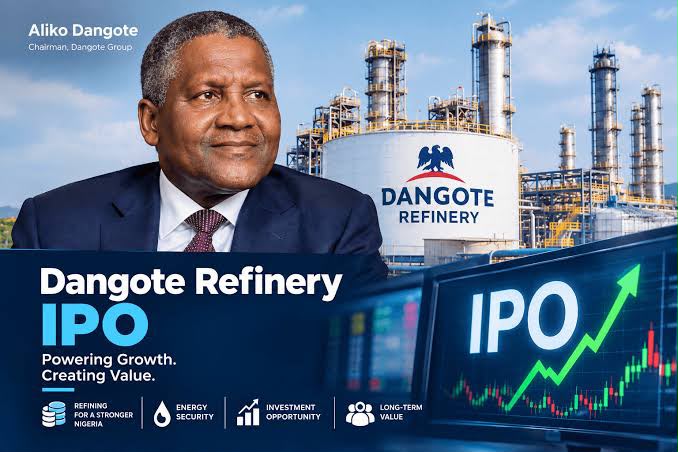
Dangote’s $1.6 billion refinery initial public offering could increase Nigeria’s active investor base by as much as fivefold, while strengthening links between the country’s capital market and other African exchanges.
Nigerian Exchange Group Chief Executive Officer, Temi Popoola, said the offering presented an opportunity to attract millions of retail investors and broaden participation beyond the relatively small number of Nigerians who actively trade.
Speaking to Reuters at the Financial Times Africa Summit, Popoola said about 5 per cent of Nigerians, approximately 12 million people, participate in capital markets, although active traders number only in the hundreds of thousands.
The offering, launched by Aliko Dangote earlier this month and scheduled to close at the end of October, is being positioned as Africa’s biggest IPO.
Popoola said marketing the shares through WhatsApp, point-of-sale terminals and basic mobile phones could help the exchange overcome years of investor outreach challenges.
“What we expect this offer to do is, make that three to five times the number of active investors that we have in the country,” he said, without providing a specific target.
Beyond attracting Nigerian investors, the exchange is using the transaction to strengthen connections with markets including Egypt, Kenya, Botswana and Ethiopia. Depositary receipt arrangements are either already in place or awaiting approval.
“Africa is being connected not just by rhetoric, but (by) real solutions on the ground,” Popoola said.
He noted that the offer could provide a test of investor demand outside Nigeria and help establish the country as a deeper source of capital for businesses across the continent.
According to him, more Nigerian companies are considering listings in London, New York and the Middle East, making infrastructure that supports share trading across different markets increasingly important.
Seplat, Airtel Africa and Guaranty Trust Holding Company already have secondary listings in London, while Dangote Cement is planning one as early as November.
Popoola said arrangements that allow shares to move between markets could improve the flow of capital and benefit investors.
“Those shares are fungible. Capital is able to flow quite freely, if we can emulate that across many other markets, it’s in the interest of our customers,” he said.
However, he acknowledged that competition from private capital was making it more difficult to attract companies to public markets, as larger businesses increasingly have alternative fundraising options.
The exchange expects fewer than 10 Nigerian companies to list over the next year.
Popoola also welcomed JPMorgan’s decision to include Nigeria’s domestic sovereign bonds in its new frontier-market local currency index.
He said renewed interest from debt investors could help pave the way for stronger participation in equities.
“That’s exactly what we are seeing now, so this is a very good precursor,” he added.