

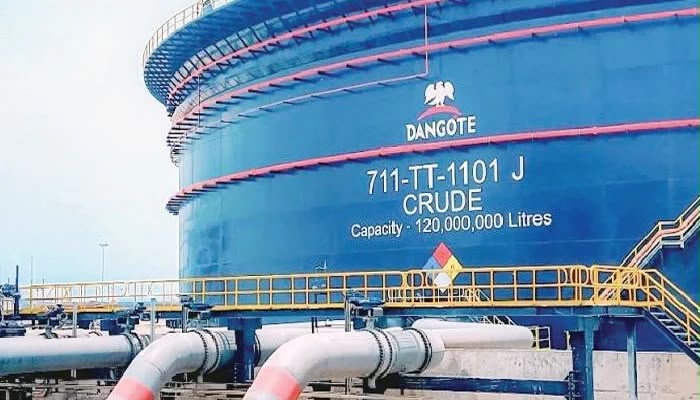
Nigeria could face a crude supply shortage as domestic refining capacity expands, operators in the midstream and downstream sectors have warned.
The concern was raised by Aliko Dangote, owner of the 650,000-barrel-per-day Dangote Refinery, during the opening of the third Nigeria Oil Refining Summit in Abuja.
The summit was organised by the Crude Oil Refinery-Owners Association of Nigeria under the theme, “Refining for Value: Linking Upstream Supply to Downstream Demand.”
Represented by the Dangote Group’s Chief Economist, Dr Hassan Mahmud, Dangote said the group’s total refining capacity across Africa could reach approximately 2.1 million barrels per day.
This would include the existing 650,000-barrel-per-day refinery in Lagos, its planned expansion to 1.4 million barrels per day and a proposed 650,000-barrel-per-day refinery in Lamu, Kenya, which could later be expanded to 700,000 barrels per day.
Dangote warned that Nigeria’s current crude production might not be sufficient to supply even its own expanding refinery capacity.
He said the situation made greater investment in upstream exploration and production essential.
“The market is there and so we should explore the opportunities,” he said.
According to Dangote, a competitive refining industry requires more than the construction of refinery plants. It depends on an integrated value chain covering crude production, transportation, storage, refining, distribution and exports.
Weakness in any part of the chain, he said, could undermine the competitiveness of the entire sector.
He urged the government to ensure reliable and competitive access to crude, a genuinely competitive downstream market, predictable policies, shared logistics infrastructure and an export-oriented strategy.
Dangote acknowledged progress under the Domestic Crude Supply Obligation established by the Petroleum Industry Act.
He cited Nigerian Upstream Petroleum Regulatory Commission data showing that approximately 53.7 million barrels of crude were supplied to domestic refineries in the second quarter of 2026, representing 97.4% compliance.
Total crude and condensate production reached about 1.7 million barrels per day in June, while domestic refinery receipts increased to approximately 683,000 barrels per day in August.
Dangote said Nigeria should ensure that any refinery ready to purchase crude on commercial terms could obtain appropriate supplies reliably and without unnecessary uncertainty.
He stressed that the proposal was not for subsidised crude but for transparent, predictable and commercially workable arrangements between producers and refiners.
He also called for a level playing field where imported and locally refined products compete under comparable tax, regulatory, quality and commercial conditions.
The Chairman of the Oil Producers Trade Section and Managing Director of TotalEnergies EP Nigeria, Matthieu Bouyer, said reforms in the oil and gas industry had created renewed investor interest.
Represented by OPTS Executive Director Gwueke Ajaifia, Bouyer said implementation of the Petroleum Industry Act, recent executive orders and new licensing activity had helped unlock more than $10 billion in upstream investments and several final investment decisions.
He said domestic refining could provide a more resilient market for Nigerian crude and reduce exposure to geopolitical and shipping disruptions, but only if domestic crude transactions were commercially attractive.
He called for market-based pricing, payment certainty, contract enforcement, fiscal stability and continued regulatory coordination between NUPRC and the Nigerian Midstream and Downstream Petroleum Regulatory Authority.
Bouyer said President Bola Tinubu’s target of raising production to 3 million barrels per day by 2030 was ambitious and could require the development of eight floating production, storage and offloading units.
The Chairman of the Independent Petroleum Producers Group, Adegbite Falade, warned that Nigeria could face a supply squeeze as domestic refining demand approaches 1.5 million barrels per day.
He said the country had the geological and technical capacity to supply refineries but lacked sufficient commercial and logistical arrangements.
Falade explained that production of approximately 1.6 million barrels per day left little room for exports, government revenue obligations, crude-backed financing, joint-venture offtake commitments, OPEC requirements, outages, crude-grade mismatches and pipeline disruptions.
He said the problem was not a shortage of reserves. NUPRC data puts Nigeria’s crude and condensate reserves at 37.01 billion barrels and gas reserves at 215.19 trillion cubic feet as of January 2026.
The main challenge, he said, was converting reserves into production and production into reliable, bankable supply.
Falade identified declining production, insecure and outdated evacuation infrastructure, the absence of a true domestic crude market and weak crude aggregation and blending systems as key structural gaps.
He called for more exploration, faster development of marginal fields and improved access to upstream financing to create additional production rather than simply reallocate scarce crude.
He also urged the government to modernise evacuation infrastructure, protect pipelines, sustain efforts against oil theft and sabotage and develop dedicated crude corridors, terminals, storage and marine logistics.
Falade supported a shift from annual crude allocations to rolling supply plans and bankable contracts involving multiple producers, grade blending, transparent swaps and efficient terminal delivery.
CORAN Chairman and OPAC Refineries Managing Director, Momoh Oyarekhua, said domestic refineries continued to face difficulty accessing crude on commercially viable terms while fuel imports persisted and refinery capacity remained underused.
He proposed the full institutionalisation of the naira-for-crude arrangement, a transparent domestic crude-pricing template, stronger enforcement of the Domestic Crude Supply Obligation and proximity-based crude swaps.
He also called for a refinery-development financing framework, shared pipelines and storage, strategic product reserves, fiscal incentives for conversion units and a clear national refining roadmap.
Industry stakeholders agreed that Nigeria’s refining ambitions would require predictable regulation, bankable contracts, stronger infrastructure and cooperation across the value chain if the country is to become Africa’s leading refining and petrochemical hub.