

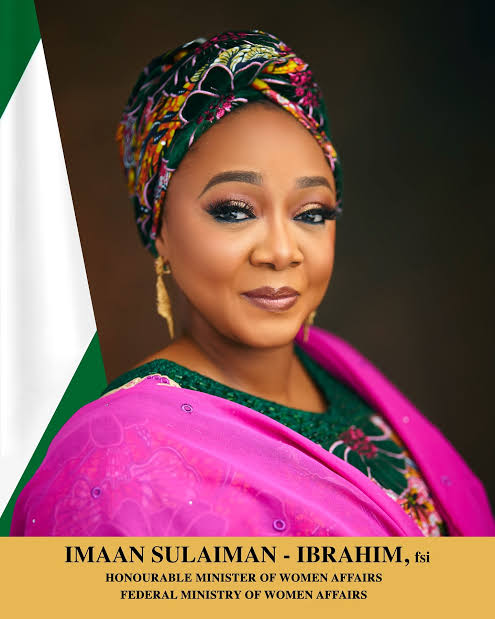
The Minister of Women Affairs and Social Development, Hajiya Imaan Sulaiman‑Ibrahim, has called for the deliberate inclusion of women in strategic sectors, particularly oil and gas, as a core driver of national development. Speaking at the 3rd Edition of the PENGASSAN Women Annual Convention 2026 in Abuja, she positioned gender‑responsive policies as a national growth imperative, not just a social aspiration.
The Minister told leaders of the Petroleum and Natural Gas Senior Staff Association of Nigeria (PENGASSAN), industry executives, and development partners that “when women rise with purpose, industries evolve; and when women unite with vision, nations are transformed.” Anchored on President Bola Ahmed Tinubu’s Renewed Hope Agenda, she framed women’s participation as a measurable development strategy designed to yield tangible outcomes rather than symbolic gains.
She described 2026, designated by President Tinubu as the Year of Families and Social Development, as a deliberate policy shift aimed at strengthening family structures and recalibrating national priorities around care systems, social protection, and inclusive growth. “Strong families are the foundation of a resilient nation, and women remain the stabilising force within both the home and the economy,” she said.
Sulaiman‑Ibrahim highlighted the gender gap in the oil and gas sector, where women reportedly make up only about 15–20 per cent of the workforce, warning that this under‑representation is not just a gap but a direct constraint on national productivity. She called for deliberate institutional reforms, noting that the sector is losing value, limiting growth, and missing critical national opportunities by failing to fully draw on female talent.
The Minister spotlighted the Federal Government’s *Renewed Hope Social Impact Intervention (RHSII‑774)* and the *Affirmative Procurement Policy* as key tools for advancing women’s economic inclusion. She explained that the Affirmative Procurement Policy is designed to move women from the margins of opportunity “to the mainstream of economic influence,” particularly in public‑procurement, contracts, and enterprise development across all 774 local government areas.
Addressing journalists on the sidelines, the Minister said the administration’s ultimate goal is to strengthen women’s economic power, which she argued will, in turn, alleviate social and political challenges. She also pointed to the emergence of a unified national platform for women’s advocacy, describing it as a turning point in how women coordinate politically and exert influence.
“In the same way we are unifying our voices, we are aligning with national policy frameworks so that sectoral action translates into institutional impact,” she said, urging stakeholders to move beyond dialogue to structured, policy‑driven engagement. “When women rise fully, strategically, and unapologetically, Nigeria will rise with them,” she added.